 Witness Record
ICE at your door
What to film, what to say through the door, and the one distinction worth knowing in advance.
Read this from an organisation, not from me, if you only read one thing. The Immigrant Legal Resource Center, the National Immigrant Justice Center and United We Dream publish know-your-rights material in multiple languages, prepared by immigration lawyers, and several offer printable red cards to hand or slide under a door. I am a developer who built a recording app. Nothing here is legal advice.
Almost everything about this situation is decided in the first sixty seconds, and almost all of it is decided by whether the door opens. That is why the filming matters: a recording of what was said through a closed door, and of what document was or was not produced, is the record of how the entry happened.
The one distinction to know before it happens
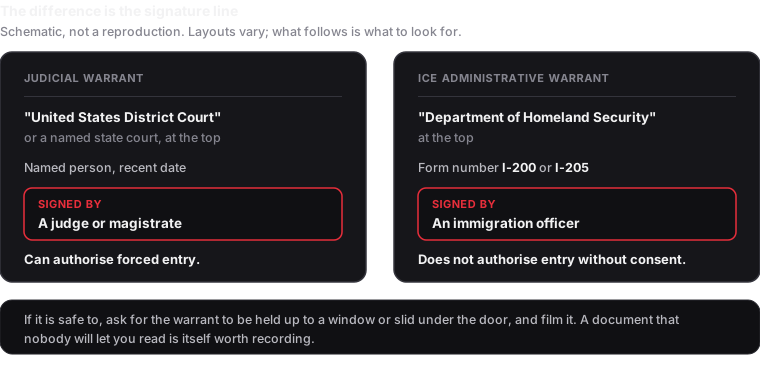
Two very different documents are both called warrants and only one of them lets anyone through a door.
A judicial warrant is issued by a court. It carries a court's name at the top and is signed by a judge or magistrate. It names the address to be searched or the person to be arrested. This one can authorise entry.
An administrative warrant is Form I-200 (arrest) or I-205 (removal). It is headed Department of Homeland Security, and it is signed by an immigration officer, not a judge. It is an internal authorisation for immigration officers to act. By itself it does not authorise entry into a home without consent.
Two practical consequences follow. The first is that "we have a warrant" is not an answer to the question; the question is which kind. The second is that this is precisely why the document is the shot.
The door stays closed
Opening the door is often treated as consent, and consent is what an administrative warrant lacks and needs. You do not have to open it to talk.
Speak through the door, or through a window. Ask them to hold any document up to the window, or to slide it under the door. Both of those are normal requests and both give you something to film.
If a document is produced, look for two things: a judge's signature, and your actual address. A judicial warrant naming a different address is not a warrant for your home.
Say it out loud, so it is on the recording. "I do not consent to your entry." Not as an argument, and not repeatedly. Once, clearly, so that it exists on the audio track. If entry happens anyway, whether you consented is very often the disputed fact months later, and your own voice is the answer to it.
Other phrases worth having ready, in whatever language you are most fluent in:
- "I am exercising my right to remain silent."
- "I want to speak to a lawyer."
- "I do not consent to a search."
- "Please slide the warrant under the door."
And what not to do: do not lie, do not present false documents, do not run, and do not physically resist. Each of those creates a new and separate problem that is worse than the one you started with.
What the recording needs to capture
Start before you go to the door
Not when you get there. The knock, the first thing said and the first question asked are all part of it, and a recording that begins after the conversation started cannot establish how it started.
This is the argument for a start method that needs no unlocking: the Action Button, a Lock Screen widget, or a spoken phrase. If you have to unlock a phone, find an app and press record, you have lost the first thirty seconds and you are also arriving at the door holding a phone and looking down at it.
Say the date, time and address out loud
In the first few seconds. It makes the recording self-locating even if the file's metadata is later stripped or questioned, and the address is the fact that a warrant has to match.
The document, if there is one
The single highest-value shot on the recording. Held to a window or slid under the door, film it steadily and long enough to be readable: the heading, the form number, the address, and the signature line. If you can read it aloud, do that too, because a shaky video of a document plus a clear voice reading it is better than either alone.
A warrant nobody will let anyone read is also worth recording. That refusal is part of the record.
Who they are and whether they will say
Ask on camera: "Who are you? What is your name? What agency?" You may get nothing, and the refusal is itself part of the record. Film any badge, vest text or credential you can see. A vest reading POLICE over plain clothes is not a local police officer and that distinction is worth having on video.
The threshold itself
If the door is opened, or opens, film where everyone is standing relative to it. Which side of the doorway, whether anyone stepped in, whether a foot or a hand was in the frame of the door. This is the geometry that memory reconstructs badly and video records perfectly.
Vehicles, and where anyone is taken
How many vehicles, what type, plates or their absence. If someone is taken, film which vehicle and which direction it goes, and say the time. This is often the most useful thing on the whole recording, because locating a person in the first forty-eight hours is the immediate practical problem for their family and the answer is frequently not made available.
If you are filming from outside
Neighbours and rapid response volunteers have the easier job and the better angle. Stay back, stay on public ground or your own property, and film from a window or a landing where you can see the whole doorway.
Do not obstruct and do not approach the door. The person inside is doing the difficult part; your job is the wide shot they cannot get, which is the one showing how many people are there, what vehicles are outside, and whether anyone entered.
Filming from inside your own home through a window is entirely reasonable and often the safest option available.
Before the day: what a household should agree
- Who films. One person, decided in advance. Not the person answering the door.
- Who calls. The local rapid response hotline, and an attorney if there is one. Different person again.
- Where the documents are. Any immigration paperwork, in one place, known to everyone.
- Who collects the children. Written down, with the school informed, and the phone number written somewhere other than in a phone.
- Red cards by the door. Printed, in the languages spoken in the house.
- The phone is set to passcode, not Face ID, and everyone knows the gesture that forces an iPhone back to passcode entry: hold the side button and a volume button for a second.
- The recording app is already connected to storage. An app that has never been linked to an account saves nothing, and nobody sets up a cloud account during a raid.
Making sure the footage survives
The specific risk here is not deletion. It is that the phone goes with the person, or into a property bag, or is simply somewhere else for the next three days, and the recording is on it.
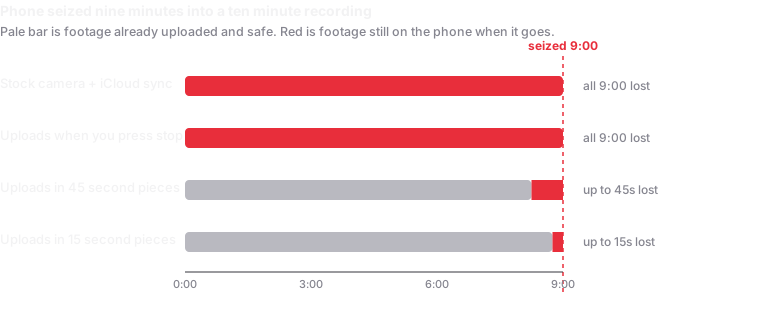
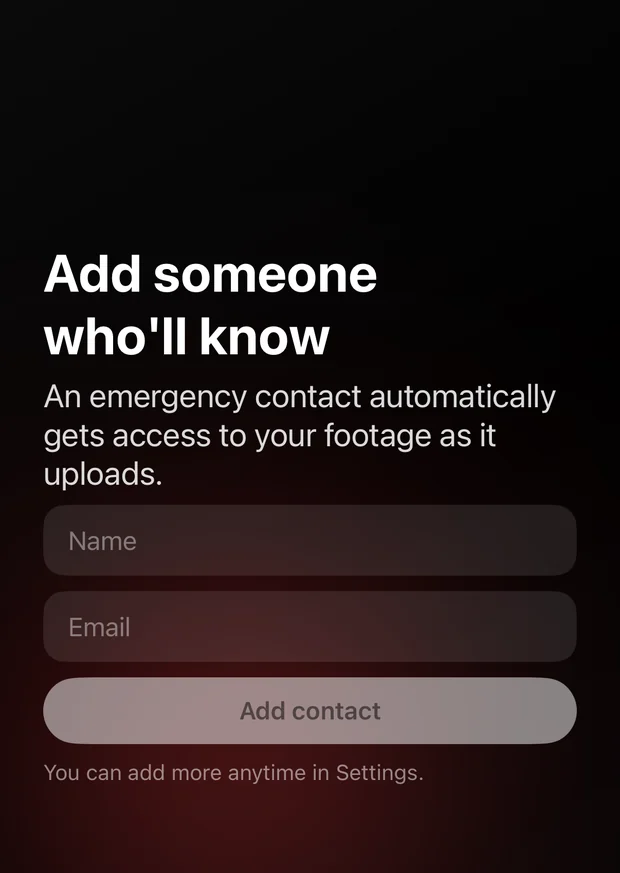
Witness, which I make, uploads in roughly fifteen-second pieces while the recording is still running, to a cloud account you own, and shares each session automatically with one contact you nominate once — which in this scenario is the point, because someone outside the house has the footage within seconds. There is no server on my end, so I hold nothing that could be subpoenaed from me. There is more than one app that uploads during recording, compared here including where mine loses.
Afterwards
- Get the footage to a lawyer or a legal organisation first. Before social media. Posting re-compresses the file and the original is what a case runs on.
- Write down everything the camera missed, the same day: names, exact words, what happened before you started filming, who was present.
- Try to locate the person. ICE operates an online detainee locator; a legal organisation can help, and the vehicle and direction you filmed may matter here.
- Blur faces before anything is published, especially other household members and neighbours. Keep the unblurred original untouched for lawyers.
- Do not send originals through messaging apps. They re-compress, which breaks verification.
Because footage of enforcement is routinely disputed, and increasingly disputed on the grounds that the video is not genuine, every piece Witness records is SHA-256 hashed on the device before it moves and the session manifest is counter-signed by an independent time-stamp authority. A lawyer can check it is unaltered without trusting you or me.
Related
- How to film ICE, by where it is happening — street stops, workplaces, courthouses and shared buildings.
- Recognising unmarked vehicles and plain-clothes agents.
- Setting up before the day.
Written September 2026. Enforcement practice and policy change, sometimes quickly. Nothing here is legal advice, and a local immigration legal organisation is a better source than this page for anything that matters.