 Witness Record
How to film ICE, by where it is happening
A street stop, a workplace, a courthouse and a home each need different footage.
Most guidance on filming immigration enforcement is written as though there is one scenario. There are about six, and the useful footage is different in each. A wide shot of a street is the whole story at a vehicle stop and almost worthless in a courthouse hallway. This page is organised by where you are.
The companion page covers recognising unmarked vehicles and plain-clothes agents, and telling a judicial warrant from an I-200. That material is not repeated here. If you have not read it, read it first; this page assumes it.
For your rights, go to the people who do this properly: the Immigrant Legal Resource Center, the National Immigrant Justice Center, United We Dream, and the NYCLU on filming ICE. I am a developer, not a lawyer, and nothing here is legal advice.
Before any of it: two settings and one decision
Passcode, not Face ID. US courts have generally treated compelling a passcode differently from compelling a face or a thumb, and the difference runs against biometrics precisely when it matters. Holding the side button and a volume button for a second forces an iPhone back to passcode entry, and works from inside a pocket.
A start method that needs no screen. The Action Button, a Lock Screen widget, or a spoken phrase. In every scenario below, the recording that matters started before you decided to start it.
Decide now whether you are documenting or intervening. They are different jobs and they interfere with each other. If a rapid response network is involved, someone should be on the phone to the hotline and someone else should be filming, and it should not be the same person.
A street or vehicle stop
The most common thing people encounter and the one where the wide shot is everything, because the entire question is usually who these people were and whether the stop happened at all.
- Vehicles first, before anything else. How many, what type, plates or the absence of plates, whether they are marked. Vehicles are the detail most likely to be identifiable later and most likely to leave first.
- Whether anyone is in uniform. A vest reading POLICE over plain clothes is not a local police officer, and that distinction is worth having on camera rather than in an argument afterwards.
- The stop's geometry. Where the vehicles are relative to the person. Boxed in, blocked, or simply parked nearby is a meaningful difference.
- The clock, out loud, repeatedly. Every couple of minutes. Duration is often the disputed fact.
- Where the person is taken. Which vehicle, which direction it leaves in, and anything said about the destination. This is frequently the single most useful thing on the recording, because locating someone in the first forty-eight hours is the immediate practical problem for their family.
A workplace
Different problem: you are probably inside, the property is private, and the number of people who did not choose to be filmed is high.
Private property means the property owner, not the agents, controls whether you can be there filming. An employer can ask you to stop or leave in a way that a public street cannot. That is worth knowing before you decide where to stand, and it is a reason to film from a doorway, a window, a car park or the pavement outside where you can.
- What is presented at the door and to whom. If there is a document, that is the shot. See the warrant question in detail.
- Whether people are being separated by area, line or shift. This is the pattern that later gets described as targeted or not.
- Whether anyone is prevented from leaving, and by what: a person, a vehicle, a locked door.
- Do not film co-workers' faces or documents unless there is a reason to. You are creating a record of who was present, and that record can be subpoenaed from you.
A courthouse
The setting with the most restrictive filming rules and the least tolerance for getting them wrong.
Courthouses commonly prohibit recording inside the building entirely, by local rule or by state statute, and violating that is contempt rather than a debate. Hallways, lobbies and security areas are usually covered. The steps, the pavement and the car park usually are not.
So: film outside, and know where the line is in your building before the day. What is worth capturing is who leaves in what, whether anyone waited in the lobby or the corridor, and the time. Several states have restricted immigration arrests at or around courthouses; whether that applies where you are is a question for a local legal organisation, not for me.
A school, hospital or place of worship
Enforcement in and around these places has been governed by internal Department of Homeland Security policy rather than by statute, which means the protection has changed with administrations and can change again. Do not assume the version you read about two years ago is current.
What that means for filming is narrow and practical. These are settings where a recording that documents where something happened carries unusual weight, because the location is itself the contested fact. Capture the building, its signage, the entrance, and any boundary or property line, with the same clarity you would give a badge number somewhere else.
Privacy runs the other way here. Children, patients and congregants have not consented to anything. Film the enforcement activity, not the people it is happening near.
An apartment building or shared entrance
The one people find hardest, because the legal line runs through the middle of the building.
A shared lobby, a corridor, a stairwell and a car park are not public streets, but they are also not the inside of anyone's home. Agents may be lawfully in a common area and still have no authority to enter an apartment. That distinction is exactly what footage can establish and memory cannot: which side of which door everyone was on, and whether a door was opened voluntarily.
If you can film from your own doorway, from a window, or from a landing above, do that rather than following people down a corridor. Height is genuinely useful here; a shot from one floor up shows the whole hallway and who is standing where.
Your own door
Filming while you are the person being visited is a different job again, and it has its own page: what to film when ICE is at your door, including the judicial-versus-administrative warrant distinction, why the door stays closed, and what to say through it.
What every one of them has in common
Narrate observable fact, not conclusion. "Four people were put into the second SUV at 7:12, plate not visible" is usable by a lawyer. Characterising motive is not, and gives anyone disputing the footage the argument that it was filmed toward a predetermined answer. Say what you can check.
Ask who they are, on camera. "Who are you? What is your name? What agency?" You may well not get an answer, and the refusal is itself part of the record. If told to stop filming, one phrasing observers use is "I am exercising my right to document this arrest," then keep your distance and keep filming.
Making sure it survives
Every guide says to have your video backing up to the cloud, and that advice is correct. The usual mechanism is weaker than people assume: photo library sync generally treats an in-progress recording as a file not yet eligible to upload, and defers on cellular or low battery besides. The result is that a nine-minute recording typically uploads nothing until you stop it, and the minutes before a phone is taken are the ones you most needed.
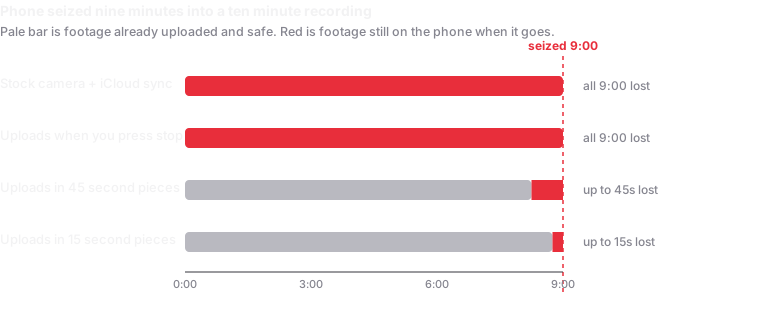
Witness uploads in roughly fifteen-second pieces while the recording is still running, to a cloud account you own, and shares each session automatically with one contact you nominate once. I built it, so weigh that accordingly; there is more than one app that uploads during recording and I have compared them including where mine loses. There is no server on my end, so there is no copy of anything to subpoena from me.
No signal, no upload. Inside a workplace, a basement corridor or a facility, pieces queue on the device until there is a connection. This is worth knowing in advance rather than discovering.
Afterwards, in order
- Get it to the attorney of record, or to a legal organisation, before you do anything else with it. Not to social media first. Footage that has been posted has usually also been re-encoded, and the original is what a case runs on.
- Write down what the camera did not get. What was said, who was present, what happened before you started filming. Same day.
- Blur faces before anything goes public. A crowd shot identifies people whose safety may depend on not being identified. Free tools on both platforms do this. Keep an unblurred original untouched for lawyers, and understand that the blurred version is a re-encode and will not match the original's hash.
- Do not send originals through messaging apps. They re-compress, which breaks verification. Share a link to the file, or the file itself.
Why an unaltered record matters more here
Footage of enforcement is routinely disputed, and increasingly the dispute is whether the video is real rather than what it shows. Every piece Witness records is SHA-256 hashed on the device before it moves, and the session manifest is counter-signed by an independent time-stamp authority, so a lawyer or a newsroom can confirm it is unaltered without having to trust you or me.
For rapid response networks
If you are coordinating volunteers rather than acting alone, three things are worth deciding centrally rather than per-person: which storage destination everyone uses, who the standing emergency contact is, and who on the team knows how to run the verification steps when footage needs to hold up. I will help set that up at no cost: olmaster13@gmail.com.
Written September 2026. Enforcement policy and the law both change, and the policy governing schools, hospitals and places of worship has changed more than once. Nothing here is legal advice.