 Witness Record
How to film at a protest
A crowd is a different job from a single encounter, and the differences are not obvious.
Filming one traffic stop is a problem of framing. Filming a demonstration is a problem of position, timing and, uncomfortably, of everyone else in the shot. The technique that produces good footage of a single arrest can produce footage that gets thirty people identified.
The step-by-step method for filming police is the foundation and this page assumes it. What follows is only what changes when there is a crowd.
Before you leave the house
Passcode, and a full charge
Face ID off, six-digit passcode or longer. Then charge to full and bring a power bank, because filming plus a crowded cell tower plus continuous upload is the worst case for a battery and demonstrations run long.
Expect the network to fail
Cell capacity at a large demonstration collapses under simple congestion, and it does so exactly when everyone is trying to upload at once. Anything that depends on a live connection should be assumed to be intermittent. Whatever you use to preserve footage should queue on the device and upload when it can rather than failing.
Write the legal support number on your arm
In marker, on skin. A number in a phone is a number you cannot reach from a holding cell without your phone. The National Lawyers Guild runs legal support at many US demonstrations and publishes local numbers in advance.
Decide your job and tell someone
Documenting and participating pull against each other. If you are there to film, say so to whoever you came with, so nobody is expecting you to be somewhere else when it matters.
Position, which is most of it
Get height where you can. A step, a wall, a doorway, a first-floor window, a car park deck. Elevation is worth more at a demonstration than at any other kind of filming, because the thing that is disputed afterwards is almost always numbers and geometry: how many people, how far back the line was, who moved first. A shot from ground level in a crowd answers none of that. A shot from four feet up answers all of it.
Film from the edge, not the middle. The middle of a crowd is where you have no exit, no context and no stable frame. The edge gives you the line, the crowd and the space between them in one shot, which is the composition that actually means something.
Know your exit before you need it, and check it again when the crowd moves. The specific hazard at a demonstration is being enclosed: a containment, a blocked side street, a line that closes behind you. If you can see only one way out, you are in the wrong place. This is not primarily about filming; it is about not being arrested for having been standing somewhere.
Do not put your back to a line. Keep officers and the crowd both in your field of view even when you are only filming one of them.
The single most useful habit: every few minutes, pan slowly across the whole scene and say the time out loud. It costs fifteen seconds and it produces the one thing lawyers consistently cannot get afterwards, which is a reliable record of what the situation looked like immediately before whatever happened next.
Film the boring part first
The footage people fail to get is not the confrontation. Everyone films the confrontation. It is the twenty minutes beforehand, which is what establishes that a crowd was peaceful, that a street was already blocked, that barricades were placed where they were, that a line formed at a particular time.
So: film the calm. Film the barricades going up. Film the size of the crowd. Film the street layout. Film officers arriving and where they position. None of it is interesting and all of it is the context that makes the interesting part provable.
Dispersal orders
If an order to disperse is given, that moment is one of the highest-value things you can capture, and it is routinely missed because it happens while everyone is filming something else.
What matters, and what is later disputed:
- Whether an order was actually given at all, and by whom.
- Whether it was audible from where the crowd was standing. Film from within the crowd, pointed at the source, so the recording captures what was actually hearable there.
- Whether it stated a route out, and whether that route was open.
- How much time passed between the order and enforcement. Say the time when the order is given and say it again when the line moves.
A recording that shows an order was given but was inaudible at the back, and that the named exit was blocked, is worth more than an hour of confrontation footage.
Mass arrests and containment
If a containment forms, the useful footage changes completely and so does your priority.
Capture the perimeter: where the line is, whether there is any gap, whether people asking to leave are permitted to. Capture time repeatedly. Capture whether food, water or toilets were provided if it goes on for hours; that is frequently the substance of subsequent claims.
During arrests, the thing to get is the pairing: which officer, which person, at what time. That is the link that connects a report to an individual months later and it is very hard to reconstruct from anything else. Badge and helmet numbers, said aloud when you can read them.
If you are inside the containment, get the footage out of the phone before anything else. A phone taken during a mass arrest may be gone for days, and the recording is on it. This is the situation the app I built exists for, and I would say the same about any of the alternatives: what matters is that footage leaves the device while you are still filming, not after.
Chemical irritants, projectiles and your own safety
Filming is not protection. If a line advances, if irritants are deployed, if projectiles are used, the correct response is to move, and it does not stop being correct because you are getting a good shot.
Practical points: a camera at eye level is a camera in the path of things aimed at eye level. Contact lenses are a bad idea where irritants may be used. Keep filming while you move rather than stopping to move; a shaky retreat is still evidence and often more informative than a static shot.
Then the part almost everyone skips
You now have footage full of people who did not agree to be filmed, at a political event, and some of them have specific and serious reasons not to be identified: immigration status, employment, an abusive ex-partner, a protection order, a country they still travel to.
Blur faces before anything goes public. Signal's image editor detects and blurs faces and is free; you can send a picture to yourself to use it. Apple Photos will let you mark up a still. There are dedicated tools on both platforms for video. Whatever you use, do it before the first post, not after somebody asks.
Two more things follow from that, and they are the ones people get wrong:
- Keep an unblurred original, untouched. Lawyers need it. Blur the copy you publish.
- Blurring is a re-encode, so the published version will not match the hash of the original. That is expected and it is why keeping the original matters. Verification runs against what came off the phone.
- Think about what else is in frame. Placards with names, faces reflected in windows, distinctive tattoos, a licence plate belonging to a participant rather than to police.
WITNESS publishes serious ethical guidance on filming protest and it is worth reading in advance rather than after you have posted something.
Making sure it survives the day
The failure mode at a demonstration is not that the footage is bad. It is that the phone is taken, dropped, out of battery, or on a network that never uploaded anything.
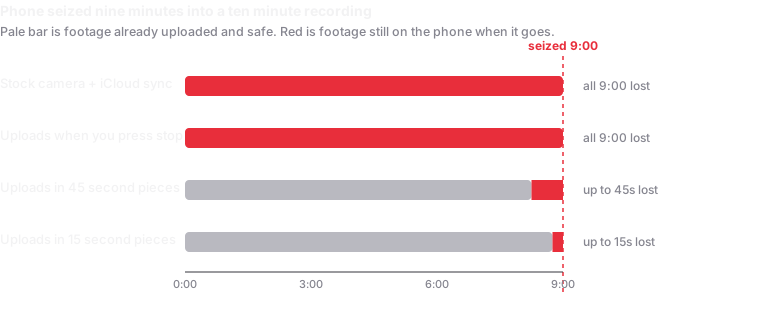
Witness, which I make, uploads in roughly fifteen-second pieces while the recording is still running, to a cloud account you own, queuing on the device when the network is congested and catching up when it is not. Each piece is hashed before it moves. There is more than one app that uploads during recording and I have compared them including where mine loses.
Afterwards
- Write it down the same day. Times, badge numbers, what was said, what happened outside the frame.
- Get footage to legal support if anyone was arrested, before you post any of it.
- Do not send originals through a messaging app. Re-compression breaks verification. Share links or the files themselves.
- Consider a records request for body-worn camera footage and dispatch audio. Retention windows for unflagged recordings can be short.
Related
- How to film the police, step by step.
- Can police take your phone or delete your video?
- What the courts have actually held, including on buffer-zone laws.
- Setting up before the day.
Written September 2026. Not legal advice, and not a substitute for local legal support. Sources: WITNESS, the ACLU and the National Lawyers Guild. No connection to WITNESS the organisation, whose name my app shares.