 Witness Record
Can police take your phone or delete your video?
Two different questions that almost everyone runs together, and a third one that matters more than either.
I am a developer, not a lawyer, and this is not legal advice. What follows is what I read while building an app around this problem, with sources, and I have tried hard not to make it sound tidier than it is.
The short version
| Question | Short answer |
|---|---|
| Can they take the phone? | In some circumstances, yes, and without a warrant. |
| Can they look at what is on it? | Generally not without a warrant, under Riley. |
| Can they delete your video? | No, and officers have been criminally charged for doing it. |
| Can they make you unlock it? | A passcode is much better protected than a face or a thumb. |
| Does any of that get the footage back? | No. That is the actual problem. |
Taking the phone and reading the phone are different things
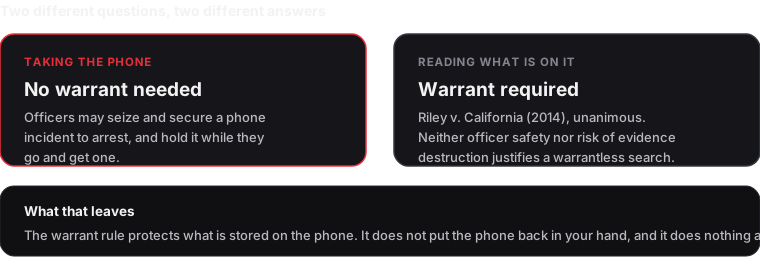
Seizure is taking custody of the device. This can happen without a warrant in a range of situations: incident to a lawful arrest, or where officers have reason to believe evidence on it would otherwise be destroyed. Courts have generally expected any such seizure to be limited in scope and duration, and to be followed by an actual warrant application if they want the contents.
Search is reading what is on it, and that is where Riley v. California (2014) sits. The Supreme Court held unanimously that the ordinary rule permitting a search of items on an arrested person does not extend to the digital contents of a phone: get a warrant. Chief Justice Roberts's reasoning was that a modern phone is not a container in a pocket but a record of a life.
Why this matters practically: the strong rule protects the contents. It does nothing to put the phone back in your hand. A phone lawfully seized and never lawfully searched can still be in an evidence locker for weeks, and the footage on it is unavailable to you for exactly that long. Riley is a privacy protection, not an access guarantee.
Can they delete it?
No. This one is not close.
Deleting footage from a phone is destruction of evidence and it exposes both the officer and the department. Officers have faced criminal charges for it: a Philadelphia officer was charged with evidence tampering, obstruction and official oppression after being filmed deleting footage from someone's phone during an arrest. Federal courts have treated deletion of a bystander's recording as a First and Fourth Amendment problem, and the Department of Justice has said so directly to police departments.
And it is close to useless to you at the time. The charge arrives months later. The footage is already gone. A rule enforced retroactively is a remedy, not a safeguard, and those are genuinely different things.
Do you have to unlock it?
This is unsettled and I am not going to pretend otherwise, but the shape of it is clear enough to act on.
Courts have generally drawn a line between compelling a passcode, which is testimony that comes out of your head and runs into the Fifth Amendment, and compelling a face or fingerprint, which has often been analysed as more like taking a physical sample and therefore not testimonial. Decisions have gone both ways, some courts have rejected the distinction, and it varies by jurisdiction.
What is not ambiguous is the practical implication: biometric unlock is the weaker protection in exactly the situation where you would want the stronger one.
Change this tonight. Use a passcode of six digits or more instead of Face ID or Touch ID. And learn the gesture: on an iPhone, hold the side button and either volume button for about a second and iOS drops back to passcode entry. It works with the phone still in your pocket.
What to say, in order
Calmly, on camera, and once each. Repeating it is arguing, and arguing is how filming becomes obstruction.
- "Am I free to go?" — establishes whether this is a detention or a conversation, and gets the answer on the recording.
- "I don't consent to a search of my phone." — the important one. Consent given is very hard to take back, and consent is how most phone searches happen. Saying it does not stop a lawful search; it preserves the question for later.
- "I'm not resisting. I'm complying." — if the phone is being taken from you, do not hold on to it. Say this instead, and let it go.
- "I want a receipt for my property." — worth asking; departments often have a process, and asking on camera is itself a record.
- "I'd like to speak to a lawyer." — and then stop talking.
What not to do: do not unlock it to show them "there's nothing on it", do not delete anything yourself, and do not physically resist. All three make your position worse and none of them protect the footage.
Is filming them lawful in the first place?
In the United States, yes, where you are lawfully present and not interfering. Every federal circuit that has squarely considered it has recognised a First Amendment right to record on-duty officers in public. The qualified-immunity analysis, meaning whether an individual officer can be sued personally, differs by circuit and by date, which is a separate question from whether the right exists.
"Not interfering" is doing real work in that sentence, and interference is the charge that actually gets used. The full write-up of the case law covers buffer-zone statutes, audio consent and the edges I could not resolve.
The question that actually decides the outcome
Every rule above is about what happens to the phone. None of them is about what happens to the footage, and the footage is what you care about.
If the recording exists only on the device, then a seizure, a drop, a smashed screen or a flat battery all have the same result. The legal protections are strong and they operate months later in a courtroom, which is the wrong timescale.
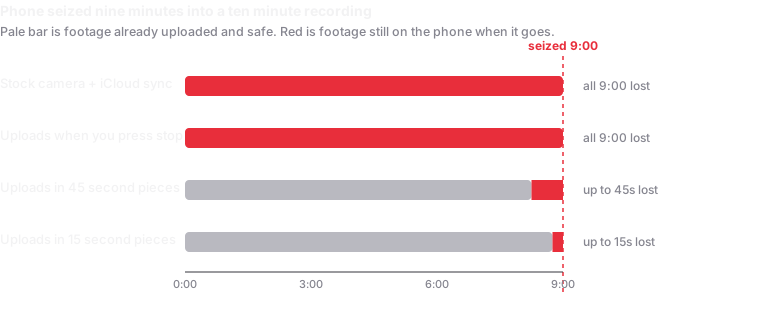
Photo library sync generally treats an in-progress recording as a file that is not yet eligible to upload, and defers on cellular or low battery besides. So a nine-minute recording typically uploads nothing at all until you stop it, and the minutes immediately before a phone is taken are the ones that mattered most.
Witness, which I built and am therefore not neutral about, uploads in roughly fifteen-second pieces to a cloud account you own while the recording is still running. A seized phone costs you seconds instead of everything. There is no server on my end, which also means there is no copy for anyone to subpoena from me. It is not the only app that does this and I have compared the alternatives including where mine loses.
If it happens anyway
- Write everything down the same day. Badge numbers, times, exact words, who else saw it.
- Get the names of witnesses, and ask whether anyone else was filming.
- Contact a lawyer or a legal support organisation before you post about it. The NLG, the ACLU affiliate in your state, or a local civil rights firm.
- File for the body-worn camera footage. Retention windows for unflagged recordings can be as short as thirty to ninety days, so ask early.
- Do not delete anything, including messages about the incident.
What I could not resolve
Buffer-zone laws are in flux. Several states have passed statutes creating minimum distances from officers and several are being litigated. Anything specific I write will age badly.
Private property changes the analysis substantially, and "in public" is carrying a lot of weight throughout this page.
Outside the United States none of this applies, and I have not researched other jurisdictions properly.
Whether specific footage is admissible in a specific case turns on jurisdiction, procedure and facts. A verifiable chain of custody removes one common objection; it does not make anything automatically admissible.
Read these directly
- EFF, Want to Record the Cops? Know Your Rights
- ACLU, know your rights for photographers
- National Lawyers Guild Legal Observer program
Written September 2026. The law changes and this page will not always keep up. Nothing here is legal advice, and I am not a lawyer.